In 1840 Bavarian botanist Carl Von Martius* began a complete census of the known species of plants in Brazil, a list which was finally published in 1906, long after his death. 22,000 species, which was an incredible achievement for the time.
The Jardim Botanico in Rio has just published online the updated version, an astronomical 37,488 plants and 3,633 fungi! Actually these are only the KNOWN species, it is estimated that there might be over 60,000 species on the final list, but no one really knows.
http://floradobrasil.jbrj.gov.br/2010/
The list breaks down into 3,496 algae and seaweeds, 1,521 mosses, 1,521 ferns, 23 conifers and cycads and 31,255 "everything else". Why so many? Well, Brazil is NOT just the Amazon, or indeed the Mata Atlantica. As well as these incredibly fertile regions there are deserts, mountains, and thousands of miles of coastline. Virtually anything can, and does, grow here.
The online database is well laid out, and not only gives synonyms but also a little map showing distribution, with a bit of luck there might even be pictures in the future, who knows.
*why was a Bavarian botanist in Brazil? That's an interesting story, but for another time
Monday, 31 May 2010

Friday, 21 May 2010
Owls on the beach
 Although the post of most intelligent animal is disputed, mythology agrees on the wisest, the owl. The Greek goddess of wisdom, Athene, was helped in her work by an owl, as was her Roman cousin Minerva, and they have been held as the sagest of creatures ever since.
The European image of an owl is a silent shadow, swooping through a dark forest, but not all owls are like that. There is one found throughout South and North America that hunts during the day, prefers open ground, and lives in burrows, the aptly named, Burrowing Owl (Athene cunicularia, from Athene and the latin for "mining").
Because they are tolerant of man, and hunt in daylight, Burrowing owls are fairly easy to see. They will even nest on beaches or derelict lots nears houses, using holes abandoned by mammals, or if the soil is loose or sandy, making their own. Then one, usually the male, will sit on the nearest tree or fencepost and keep watch.
Burrowing owls have quite a few enemies, and so the deeper the hole, the better. The chicks are raised there, but it's used through the whole year as a roost and shelter. In fact outside the breeding season nearly 40% of the time can be spent underground. When the chicks appear though it's "all hands to the pumps" and one or other parent will be hunting 24 hours a day.
They're pretty omnivorous, eating almost anything that moves including mice, beetles and even scorpions, and unusually for owls they'll also eat seeds and nuts. The preferred method is to sit on a post and ambush anything they see, but if times are hard, or there are chicks to feed, the males can range over several kilometres looking for food.
Burrowing owls are quite visually orientated, and if they do hunt at night they're more active when there is a full moon. They prefer clear open ground where they can see danger, or food, approaching. This preference has one extra advantage in the modern world, deforested land is ideal habitat for them ,and their numbers are actually increasing.
Tuesday, 18 May 2010
Fire at Butantan
I wrote in an earlier blog about the Butantan Institute in Sao Paulo, which amongst other things had the largest collection of live and preserved poisonous animals in the world. Snakes, spiders and scorpions kept both for the production of anti-venom, and also for identification of animals found in the wild, and for research.
Unfortunately early on Saturday morning the collection building caught fire, and the entire collection of 80,000 preserved snakes, and about 450,000 spiders and scorpions was destroyed. Incredibly there was no sprinkler system, or even a fire alarm - even more surprising when you consider that the specimens were stored in ethanol!
Still, miraculously, the early hour meant that no one was hurt, and the live snakes required for anti-venom survived. Nonetheless Brazil has lost a unique resource that will be extremely hard to replace.
Unfortunately early on Saturday morning the collection building caught fire, and the entire collection of 80,000 preserved snakes, and about 450,000 spiders and scorpions was destroyed. Incredibly there was no sprinkler system, or even a fire alarm - even more surprising when you consider that the specimens were stored in ethanol!
Still, miraculously, the early hour meant that no one was hurt, and the live snakes required for anti-venom survived. Nonetheless Brazil has lost a unique resource that will be extremely hard to replace.
Friday, 30 April 2010
Who's a clever boy then?
Recently there was a paper published on an obscure species of crow on a small island in the Pacific, and it made the BBC news. The reason was the extraordinary intelligence of the crow. Not only do they use tools in the wild to find food, but they actually make them, whittling wood and tearing leaves. They are the only species of bird known to do this, and better yet, they are problem solvers. Faced with a puzzle where they had to pull up a string with a small stick on the end, use this to get a larger stick and in turn use this to obtain food, one bird (called Sam) spent 110 seconds looking at, then solved the puzzle straight of the bat. Others were not so bright, but they got their in the end.
http://news.bbc.co.uk/2/hi/science/nature/8631486.stm
Of course the corvids - crows, ravens, jackdaws and magpies - have been renowned for their intelligence from the days of Aesop. Stories abound of their cunning and intellect, and this is starting to be borne out by science. For example, the magpie is the only non-primate known to recognize itself in a mirror, showing at least some self-awareness.
So why aren't birds masters of the universe? One limiting factor is brain size, although birds seem to use a different part of the brain for thinking, size is stiil linked to intelligence. Birds are limited by the necessity to fly, and brains are both heavy and hugely demanding of energy. The human brain uses 25% of the bodies energy, though it's only 2% of the weight. In order to fly many bats have had to evolve smaller brains, not larger.
Some birds of course have given up flight, such as the ostrich, but they are not obvious candidates for high intelligence.
 Intelligent?
So, where does this leaves the Mata Atlantica?
Well there are not many crows here, but there are parrots, and they are pretty bright. African grey parrots have a high brain to body ratio, and can, for example, learn the meaning of quite a few words and count up to six. The Kea, from New Zealand, is extremely adaptable and opportunistic, with a very complicated soical system, and it too can solve simple problems, though not as well as the crows.
Brazilian parrots and parakeets are certainly social and (very!) vocal. The earliest Portuguese settlers amused themselves but teaching captive parrots to speak Portuguese, and the best sent back to Lisbon, leading to a popular local saying " the well-spoken parrot goes to Portugal". As yet there are few studies of local species, but the Hyacinth macaw, the largest flying parrot in the world, seems to pretty clever.
However, the limitations of flight still apply. But... in the past there were birds in the Mata Atlantica that were flightless, and had HUGE heads, the terror birds. One for example had a skull about the same size and length as that of a horse, so were they especially bright? Well, a big skull doesn't necessarily mean a big brain, in this case over half was taken up with an enormous, crushing beak, which also required muscle attachments, and two large eye sockets. So, it was big and mean, but maybe, just maybe, it was a little smart as well.
http://news.bbc.co.uk/2/hi/science/nature/8631486.stm
Of course the corvids - crows, ravens, jackdaws and magpies - have been renowned for their intelligence from the days of Aesop. Stories abound of their cunning and intellect, and this is starting to be borne out by science. For example, the magpie is the only non-primate known to recognize itself in a mirror, showing at least some self-awareness.
So why aren't birds masters of the universe? One limiting factor is brain size, although birds seem to use a different part of the brain for thinking, size is stiil linked to intelligence. Birds are limited by the necessity to fly, and brains are both heavy and hugely demanding of energy. The human brain uses 25% of the bodies energy, though it's only 2% of the weight. In order to fly many bats have had to evolve smaller brains, not larger.
Some birds of course have given up flight, such as the ostrich, but they are not obvious candidates for high intelligence.
 Intelligent?
So, where does this leaves the Mata Atlantica?
Well there are not many crows here, but there are parrots, and they are pretty bright. African grey parrots have a high brain to body ratio, and can, for example, learn the meaning of quite a few words and count up to six. The Kea, from New Zealand, is extremely adaptable and opportunistic, with a very complicated soical system, and it too can solve simple problems, though not as well as the crows.
Brazilian parrots and parakeets are certainly social and (very!) vocal. The earliest Portuguese settlers amused themselves but teaching captive parrots to speak Portuguese, and the best sent back to Lisbon, leading to a popular local saying " the well-spoken parrot goes to Portugal". As yet there are few studies of local species, but the Hyacinth macaw, the largest flying parrot in the world, seems to pretty clever.
However, the limitations of flight still apply. But... in the past there were birds in the Mata Atlantica that were flightless, and had HUGE heads, the terror birds. One for example had a skull about the same size and length as that of a horse, so were they especially bright? Well, a big skull doesn't necessarily mean a big brain, in this case over half was taken up with an enormous, crushing beak, which also required muscle attachments, and two large eye sockets. So, it was big and mean, but maybe, just maybe, it was a little smart as well.
Saturday, 17 April 2010
Eucalyptus
Yes, another import, but to be fair you are rather more likely to see Eucalyptus than many indigenous tree species - there are approximately 5 million hectares planted in Brazi! 
Of course, for day to day use, Eucalyptus is best known for it's oil, which is not only clears your nose, but is a powerful disinfectant. And, it's flammable. On hot days clouds of oil rise from the trees and it is not unknown for trees to spontaneously explode! Certainly forest fires spread easily and the tree itself is well adapted to regenerate after fire, growing back from it's base (another reason it is useful in forestry).

What does this huge plantation mean for the environment, beyond the obvious loss of natural habitat? Well apart from the increased risk of forest fires, Eucalypts are extremely demanding of water, they can even be used to drain swamps. And, by themselves, they have little to offer the endemic wildlife as there are, sadly, no koala bears in Brazil. A study of bird species found only 8 of the 200 endemic to the Mata Atlantica, though this is partly because the understory is cleared in commerical forests. This included foragers like the Ruddy ground dove (Columbina talpacoti) and our old friend the Bananaquit (Coereba flaveola), who was probably feeding on Eucalyptus flowers, which are very high in nectar.
 One way of looking at it though is to consider Eucalyptus as a "crop". If the forest understory is left, quite a few species can still survive, at least in comparison to other "crops" such as sugar cane or maize.It could be worse.
Why Eucalyptus particularly? Well, Eucalyptus stands are extraordinarily productive, especially in Brazil where the climate is perfect for growth. In fact, Brazil holds the world record, with an astonishing 100 cubic metres per hectare per year! This is not purely a question of climate, Brazil has invested heavily in Eucalyptus forestry, so much so that they are now the worlds largest exporter of both wood and pulp, and even offer production advice to Australia.

The wood is not especially good for construction, but it is excellent for both charcoal (for iron production) and especially paper manufacture. Even so, I'm told that the major newspapers in Sao Paulo cannot get enough paper and have to import.

The wood is not especially good for construction, but it is excellent for both charcoal (for iron production) and especially paper manufacture. Even so, I'm told that the major newspapers in Sao Paulo cannot get enough paper and have to import.

Of course, for day to day use, Eucalyptus is best known for it's oil, which is not only clears your nose, but is a powerful disinfectant. And, it's flammable. On hot days clouds of oil rise from the trees and it is not unknown for trees to spontaneously explode! Certainly forest fires spread easily and the tree itself is well adapted to regenerate after fire, growing back from it's base (another reason it is useful in forestry).

What does this huge plantation mean for the environment, beyond the obvious loss of natural habitat? Well apart from the increased risk of forest fires, Eucalypts are extremely demanding of water, they can even be used to drain swamps. And, by themselves, they have little to offer the endemic wildlife as there are, sadly, no koala bears in Brazil. A study of bird species found only 8 of the 200 endemic to the Mata Atlantica, though this is partly because the understory is cleared in commerical forests. This included foragers like the Ruddy ground dove (Columbina talpacoti) and our old friend the Bananaquit (Coereba flaveola), who was probably feeding on Eucalyptus flowers, which are very high in nectar.
 One way of looking at it though is to consider Eucalyptus as a "crop". If the forest understory is left, quite a few species can still survive, at least in comparison to other "crops" such as sugar cane or maize.It could be worse.
Saturday, 10 April 2010
Underneath the Mango Tree
Underneath the mango tree,
Me honey and me,
can watch for the moon.
Underneath the mango tree,
Me honey and me,
make boolooloop soon.
(from Dr No)
Mangoes are yet another gift from India to the world, not least to Brazil, which produced 1.5 million tons of the fruit in 2007. In fact the word "mango" comes from the Malayam word "manna" via the Portuguese "manga", the Portuguese yet again spreading plants through their empire. By 1768 Captain Cook was reporting that they were grown in great abundance around Rio.can watch for the moon.
Underneath the mango tree,
Me honey and me,
make boolooloop soon.
(from Dr No)
 The mango tree itself is tall (up to 130ft) and stately, and long lived, up to 300 years. Most Brazilian mangoes are grown in the north, but there are some in the Mata Atlantica region and it is not uncommon to see mango trees in gardens and parks. For instance, the Solar Monjardim, a mansion and museum house in Vitoria, is surrounded by shade giving mango trees. The shading effect is supposed to be quite calming, being recommended by both Buddha and the James Bond movie Dr No, as can be seen from the lyrics above.
 There are 100s of varieties of Mangoes, but the commonest for export, and which accounts for 80% of those in UK supermarkets, is Tommy Atkins. Not the most delicious, but it travels extremely well and doesn't bruise with handling, unlike some other types. It accounts for about 80% of Brazilian commercial mango production. Of course if you are lucky you can get mangoes fresh from the tree.
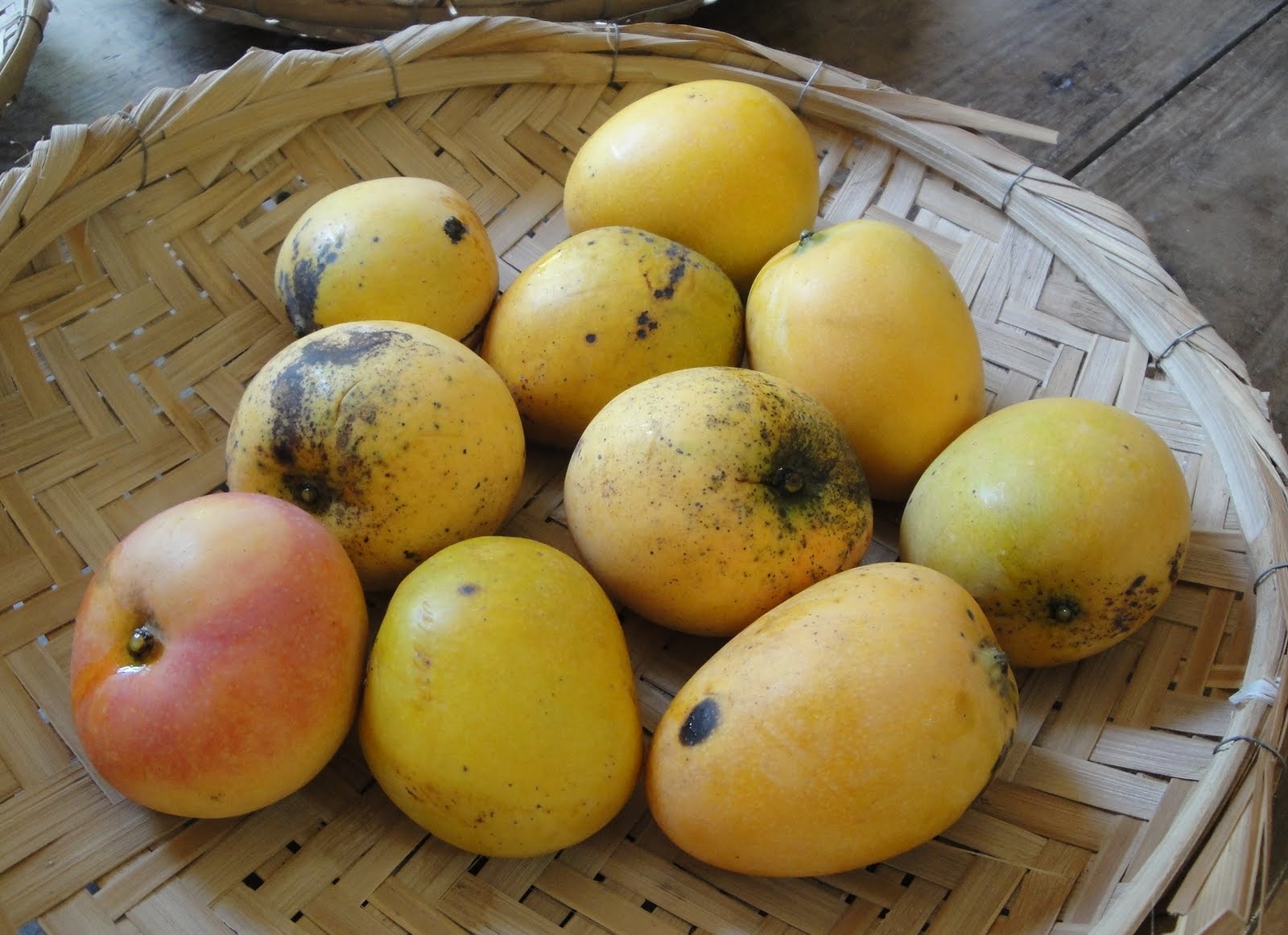 Mangoes are an excellent source of vitamin C, and the yellow colour comes beta-carotene, a source of vitamin A. There are of course lots of ways to eat mangoes, and drink their juice. One of the most delicious is Mango batitida......
Mix peeled mango, condensed milk and crushed ice in a blender. Add cachaca (rum) to taste. Actually this works very well with pineapple, and especially passion fruit, as well.
Thursday, 1 April 2010
(The) Brazilian Duck
 This is a duck, it's in Brazil, and it's name is the Brazilian Duck, which is at least informative, as far as it goes. Actually it's range extends from Venezuela to Argentina, but the majority are, probably, Brazilian.
 Again as the name implies, Brazilian ducks are reasonably common. They live in pairs or groups of up to 15, eating seeds, roots, insects and, it has been claimed, fish. The ducklings eat exclusively insects, which has to be a good thing in Brazil, where there are altogether too many insects such as mosquitoes with aquatic life cycles.
 A little drab on the ground, in flight Brazilian ducks display their iridescent green wings. They can also be recognised, apparently, by a loud "weeping whistle" in flight and a habit of flying low over the water.
 And that's it!, almost all I could find - and half that is from a guide to hunting them! Even scientifically, the only publications are on a rather stale taxonomic debate and an apparent susceptibility to every parasite going.
I know they're small and brown and unobtrusive, but surely they deserve a little more regard than that? Even the name displays a lack of interest, a half hearted attempt to call them Brazilian teals is not much of an improvement. Why not the Guarani dabbler, or Samba pochard or something?
Anyway, that is the Brazilian Duck.
Subscribe to:
Posts (Atom)