Wednesday, 14 March 2012

Kelp gulls

As I've mentioned before, you won't find sea gulls on the beaches of Copacabana or Ipanema in Rio. However, go further south, down to Santa Catarina and beyond, and they do start to appear. One of the commonest is the Kelp Gull, or Larus dominicus - the "dominicus" part coming from the Dominican order of friars who also had black and white plumage. In Brazil it's known as the "Gaviota dominicana".


In fact, the Kelp gull is not just found in Brazil, but all over the southern hemisphere, from the Falkland Islands to South Africa to New Zealand and Australia. As with many successful species they are ominvores, eating almost anything, which means that like their northern cousins they flock to waste sites and rubbish tips. Also, rather nastily, they seem to have a habit of pecking into whales when they surface. Slightly more admirably, they seem to be intelligent enough to use tools, or at least use stones to smash open mussel shells. They also pick up mussels and drop them from a great height, quite a common sight on the Falklands apparently.


The one thing don't eat is kelp, or seaweed - the name probably comes from seeing them investigating weed washed up on the shore looking for molluscs or insects.

Monday, 23 January 2012

Fuchsias

The ancestors of the fuchsias that brighten your garden were once growing in the forests of Central and South America. Exactly how they got to England is a bit of a mystery as there are many differing stories. One has a sea captain in the 1790s, Captain Firth, bringing a plant back from a voyage to the Americas and giving it to his wife who lived in Hammersmith. She liked it and planted it on her window sill where a local horticulturalist, James Lee, saw it. Now, fashionable society was in the middle of a plant collecting craze, and recognising a gold mine when he saw one he offered an incredible 80 pounds for the single plant. He knew what he was doing as he then sold cuttings for 10 to 20 pounds each. The popularity of the new flowers grew, with a desire for new forms- there are over 110 natural species of fuchsias, so almost endless possibilities for hybridisation, leading to the huge variety of colours and shapes seen today.


This is Fuchsia regia, "brinco-de-princesa". More a vine than a tree or shrub, it can grow over 20 ft high, supporting itself on other plants as it struggles to reach the light. It's found from Minas and Espirito Santo down to Argentina, though generally only growing above 700m in the hotter latitudes. These were found at the Itaimbezinho canyons near Porto Alegre in the south of Brazil, part of the amazing Aparados da Serra National Park, where they are often shrouded in mist at night.

Regia was one of the original fuchsias used for plant breeding, and is still used for this today as it's a) very pretty, b) vigorous and c) resistant to the Fuchsia gall mite (Aculops fuchsiae, which also comes from Brazil). You can actually use it as a garden plant, but it needs an awful lot of pruning.

Friday, 23 December 2011

The Nativity Bird

Adoration of the Shepherds by Charles LeBrun 1689

All over the Christian world at this time of year you will see Nativity scenes - Jesus, Mary and Joseph in the stable. In the background there will be horses, and perhaps sheep brought by the shepherds, but one crucial animal is missing, one that undoubtedly was flitting around the stables of Bethlehem, the sparrow.

Sparrows (Passer domesticus) originated in the Middle East, and it would have practically impossible to keep them out of a stable. They would probably roost there, and later in the year there would be sparrow nests in the eaves. Where you have one sparrow you have several, being very gregarious little birds. Even in Biblical times they were so familiar as to be taken for granted - in the Gospel of Mathew, Jesus notes how (even) the flight of a sparrow is noted by God.

So common then, and common now, probably the most widely distributed bird in history. They tied their destiny to humans many many years ago, and it's worked. They flourish wherever man does, in his cities and on his farms. But why?


Firstly because they like cereal seeds, and man grows cereals, and make bread. But beyond that they are extremely adaptable. Whilst many birds are picky about nest sites, sparrows will nest almost anywhere, although they prefer holes in trees. The eaves of buildings are common, and almost any dense tree or shrub, but even street lights, apparently attracted to the warmth.

This brings us to the sparrow's 2nd advantage. They are immensely tolerant, "a bold and cheeky bird, but very wary and difficult to approach closely" according to my copy of the Ladybird Guide to British Birds (1956)*. Unlike many birds the noise and confusion of a modern city simply doesn't seem to bother them. Add an above average intelligence, a robust immune system, high fertility and amazing longevity (up to 23 years in captivity and even 19 years in the wild for one Danish bird) and you see why there are so many of them.


And, they're cute. They're tame and friendly and nice to watch. This is more of an evolutionary advantage than you might think. Sparrows were deliberately released into the Americas, in Brooklyn in 1852 and Buenos Aires in 1870, apparently as the teeming European immigrants missed having them around - they're now found from the Northern Territories of Canada to Tierra del Fuego. They are the commonest birds, with pigeons, in many Brazilian cities, from Porto Alegre in the south to Ipatinga in Minas Gerais, and they have even reached the edge of Amazonia.
Where there is man, there are sparrows.

So when you imagine the Nativity scene, shepherds, kings and a baby gurgling in the manger, add a few little brown birds flitting around in the background.

*Brian Vesey-Fitzgerald. The third book of British birds. Ladybird

Wednesday, 21 December 2011

EVERYTHING you ever wanted to know about the plants of the Amazon

A 353 page book has just been published, Fruit Trees and Useful Plants in Amazonian Life.

A co-production of the Food and Agriculture Organization (FAO), the Center for International Forestry Research (CIFOR) and People and Plants International (PPI) it aims to describe all the commercially or medically important plants in the Amazon region, and it is amazingly comprehensive.

For example
For the Buriti Palm (Mauritia flexuosa) there is a description of it's ecology, how they can be cultivated, the average yield (up to 360 kg per tree in a year!), economics (1 litre of Buriti juice costs about $1) and a COMPLETE guide to it's possible uses, including how to make traditional toys.
There is a description of the cultural significance of the plant, the animals that eat the fruit or nest in the branches, and even a recipe for Buriti frozen creme! All illustrated with line drawings.

And, the guide is free! It can be found at...
http://www.fao.org/docrep/015/i2360e/i2360e.pdf

Friday, 16 December 2011

Nasty little spiders

The prime time news on Brazilian channel Globo recently showed a report on spiders*, specifically "Aranhas marroms", or "brown spiders" (translations never sound so impressive!). These little spiders might not look much, perhaps a bit larger than a normal spider, but they are a big problem.


"Brown spiders", (mostly Loxosceles similis) are found through out Brazil, from Para down through Minas and Sao Paulo to Rio Grande de Sul, with the southern state of Parana being something of a hotbed. However, unlike many spiders, the young don't make silk parachutes to travel on the wind and they've only got little legs, so they don't travel very far - colonies tend to be very dense, but localised. They're timid animals and will generally try to hide from humans, but 5,000 people are bitten each year, leading to fevers, skin lesions, and even death. So why is such a little spider so dangerous?

Well, it's all to do with their venom, which is incredibly toxic. Unlike some snake venoms, it's not neurotoxic as such, so victims don't go into paralysis or spasms, it is necrotic, which means that cells just die. Depending on how good a bite it got in, this can cause a little lesion the size of a bottle top, to one up to 40 cm wide. If this gets infected, or the toxin is carried in the blood stream to other organs (which is rare) the consequences can be very serious. The bizarre thing about their venom is that whilst some mammals such as rabbits and humans are very susceptible, mice and rats aren't, goodness knows why.

So what to do?

Avoidance

Virtually all cases of bites have been from spiders forced into close contact, by someone picking them up, or they were in clothing or shoes, so shake out any clothing. Don't, what ever you do, spray them with insecticide! It causes a nervous reaction making them very aggressive and much more likely to bite!

Treatment

If you suspect you've been bitten, wash the site with soap and water, but don't try to squeeze or suck out the venom, you'll just spread it around. Go straight to a doctor, with, if possible, the spider - treatment is by anti-venom and it helps to know who bit you!

Every year, specialised (and very brave!) teams go out hunting around the southern city of Curitiba and catch thousands of spiders, which are "milked" for their poison. This is used to make the anti-venom. about 20,000 doses per year, to be distributed to hospitals all over Brazil.The actual technique used to make the anti-venom is explained nicely in the Globo piece.

Be nice to geckos

The principle predators of brown spiders are geckos, which presumably are immune to their toxin.

* The news report can be found here....
http://g1.globo.com/jornal-nacional/noticia/2011/12/agentes-cacam-aranha-perigosa-em-regioes-do-parana.html

Wednesday, 26 October 2011

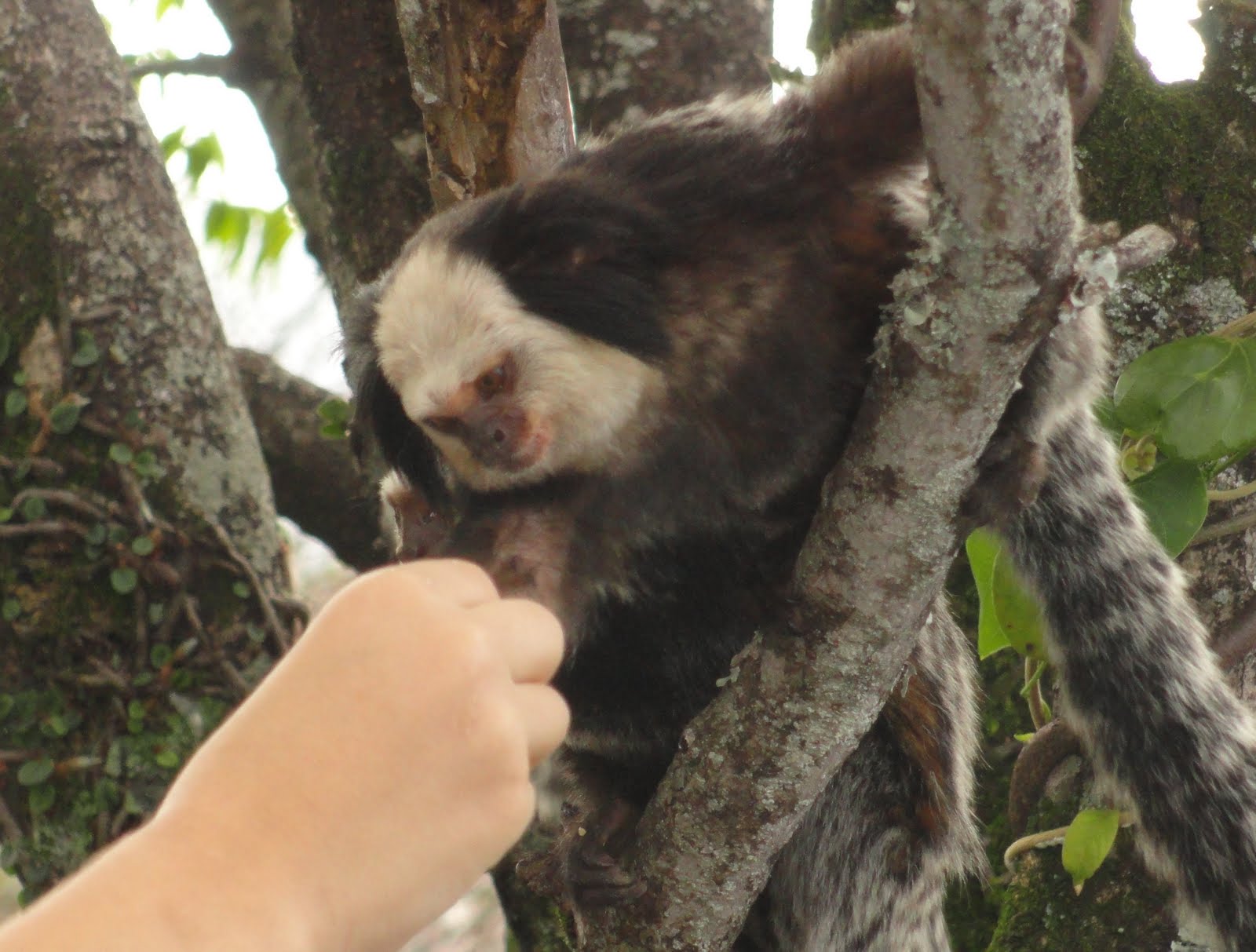
Little monkeys

These charming creatures are "saguis" (marmosets), in fact "Saguis de cara branca", White headed marmosets (Callithrix geoffroyi). One of the tamest wild animals, they are great favourites of tourists, eagerly taking fruit in their little hands. Without tourists, they have to fend for themselves, groups travelling up to 2 km through the forest. They eat fruit and any small creatures they can find, insects, snails or even frogs. They also eat a surprising amount of gum from trees and lianas, either gouging wounds in trees or searching for wounds made by insects. Gum apparently has a lot of carbohydrates, so it is sweet and gives lots of energy to little monkeys.


And saguis are little, which means they need lots of high energy food, but they can turn out to be food themselves. Hence the frequent nervous glances up to detect any eagles or falcons. Mothers carrying young seem to settle for fruit and gum, hunting for tasty insects takes too much attention, and they are too ungainly to bolt if needed. If predators appear there are basically two options. If they see a raptor, there is a brief cry and then they freeze still under cover. But if it is not immediately dangerous, a cat on the ground for instance, they will mob it - harassing it from above as a group and making loud "tsik" calls. Strangely, it has been shown that being part of a "mob" actually reduces rather than increases monkey stress - it is tempting to extrapolate that to humans!


One curiosity of saguis, and other new world monkeys, is that some individuals are trichomatic, and some dichromatic. What does this mean? Humans and higher apes have three different colour cells in their eyes, in combination they can distinguish up to 1 million colours. Most mammals have just two types, so can distinguish only about 10,000, kind of equivalent to colour blindness. So why are some monkeys one type, others another? Apparently trichromatic monkeys are better at finding fruit, especially when its red, but dichromatic monkeys see better in the low light of dawn and dusk, so it all balances out in the end.

Saturday, 22 October 2011

The Owl of Buenos Aires

No, this is the "other" Buenos Aires, a pretty valley in the hills above the Brazilian coastal town of Guarpari.

On a visit there I saw various birds flitting around, from finches to a circling eagle, but the one that really caught my attention was this Burrowing Owl (Athene cunicularia - say "cunicularia" and you will see how it is a good name for an owl!).

I have blogged about Burrowing owls before (http://wordsofthemonkey.blogspot.com/search/label/Athene%20cunicularia) , so for now, here are just some pictures.........


... and his (her?) burrow